How to Choose the Right Rubber Lined Carbon Steel Pipe?

Time:2026-10-27 Author:Henry
0%

Choosing the right Rubber Lined Carbon Steel Pipe begins with the service environment, not the product catalogue. A pipe carrying dilute acid may need a different lining from one transporting abrasive mineral slurry. Temperature, concentration, flow velocity, pressure, and suspended solids all influence performance. Small changes matter. A few degrees can accelerate chemical attack.

Dr. Pierre R. Roberge, a respected corrosion engineering authority, offers a useful principle: “Understand the environment before choosing protection.” This idea remains practical for Rubber Lined Carbon Steel Pipe selection. Engineers should examine the process fluid, operating cycles, cleaning chemicals, and expected maintenance conditions. They should also confirm lining thickness, rubber compound, adhesion strength, hardness, and spark-test requirements. The carbon steel shell must match pressure demands and connection geometry. Flanges deserve attention. Poor alignment can damage the lining before commissioning.

Field experience often exposes weaknesses that specifications miss. A pipe may pass factory inspection but fail after repeated thermal cycling. A seemingly suitable rubber grade may swell in an unexpected solvent. That is not a design failure alone. It is a reminder to question assumptions.

Reliable selection combines laboratory data, manufacturer experience, and site evidence. Ask for chemical-resistance charts, inspection records, and documented quality procedures. Check how the pipe will be transported, stored, installed, and repaired. Do not treat these steps as paperwork. They protect the lining.

There is no universal solution. The right Rubber Lined Carbon Steel Pipe balances corrosion resistance, abrasion protection, mechanical strength, service life, and total cost. Careful decisions begin with uncomfortable questions.
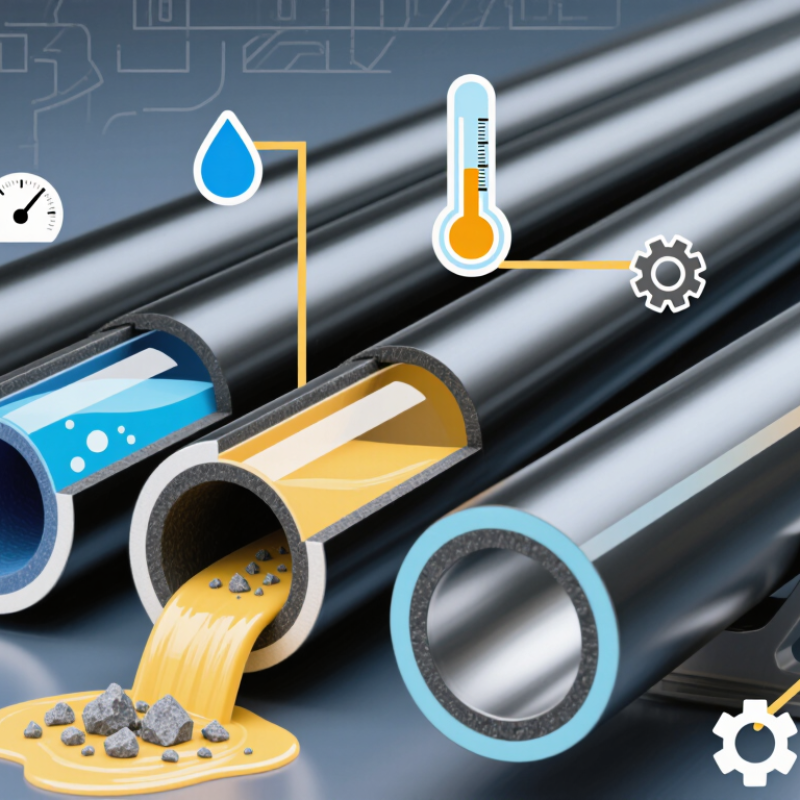
How to Choose the Right Rubber Lined Carbon Steel Pipe?

Define the Application and Operating Conditions

Choosing the right rubber lined carbon steel pipe starts with a clear definition of the application and operating conditions. Identify the conveyed material, including its acidity, particle size, temperature, concentration, and flow speed. Slurry with sharp mineral particles can wear rubber quickly if the velocity is excessive. A chemical liquid may require different rubber compatibility.

Pressure and temperature also matter. Check normal pressure, surge pressure, vacuum conditions, and temperature changes during start-up or cleaning. Rubber linings can soften, swell, or lose adhesion when exposed to unsuitable heat or chemicals. Do not rely on a general “chemical resistant” label. Request compatibility data and compare it with the actual process fluid.

Tips: Record the highest temperature, not only the average. Measure the largest solid particles and expected flow rate. Ask for lining thickness, hardness, adhesion testing, and spark-test procedures. Include drawings showing bends, reducers, flanges, and support points. These details often reveal risks before fabrication.

From field inspections, many failures begin with incomplete operating data. A pipe may perform well in a test line but fail after a cleaning cycle or unexpected pressure surge. That possibility deserves attention. If conditions change seasonally, select materials for the most severe credible case. Confirm the design with qualified engineers and documented test results. When uncertainty remains, a small trial section may provide more reliable evidence than assumptions.

Select the Suitable Rubber Lining Material

Selecting the right rubber lining material is central to carbon steel pipe performance. The fluid, temperature, pressure, and flow speed should guide the decision. Natural rubber often suits abrasive slurries because it absorbs impact well. It can protect against sand, mineral particles, and repeated friction. However, it may perform poorly with oils, solvents, and elevated temperatures.

Neoprene can offer better resistance to oils, weathering, and moderate chemical exposure. EPDM is often considered for water, dilute acids, and alkaline solutions. Yet, chemical compatibility depends on concentration and operating temperature. Temperature changes everything. A lining suitable at 25°C may weaken quickly at 70°C. Laboratory charts help, but they cannot replace process data from the actual site.

Experienced engineers also check lining hardness and thickness. A soft lining may reduce impact damage, while a harder grade can resist cutting. The correct choice is rarely based on hardness alone. Pipe bends, reducers, and pumping conditions deserve attention. I have seen specifications fail because they ignored sudden pressure changes. That mistake is easy to repeat. Before installation, confirm adhesion, surface preparation, and spark-test requirements. Inspectors should record thickness readings and repair small defects immediately. A reliable supplier should provide test evidence, chemical limits, and practical installation guidance. When the fluid composition is uncertain, request a sample analysis instead of guessing.

Determine the Pipe Size, Pressure, and Temperature Ratings

How to Choose the Right Rubber Lined Carbon Steel Pipe?

Selecting a rubber lined carbon steel pipe starts with the operating conditions, not the purchase price. Confirm the required internal diameter from flow rate, fluid viscosity, and acceptable pressure loss. Slurry systems may need a larger bore to reduce settling and abrasion. Check flange dimensions carefully. A small mismatch can delay installation.

Pressure ratings must cover normal operation, startup surges, pump shutoff, and possible vacuum conditions. The steel shell and rubber lining have different limits. Use the lower allowable rating as the practical boundary. Temperature also matters. Confirm continuous and peak temperatures, including cleaning cycles and sudden changes. The lining must resist the fluid chemically at the actual temperature, not only at room temperature. A neat calculation can still mislead.

Tips: Ask for certified material data, lining hardness, spark-test results, and pressure-test records. Compare the pipe rating with the weakest flange, gasket, valve, or fitting. Leave a safety margin. I have seen projects focus on nominal size while ignoring thermal expansion. That mistake can create stress near supports and joints. Review the design with an experienced engineer, especially when solids, pulsation, or frequent temperature changes are present.

Evaluate Manufacturing Quality and Corrosion Resistance

Choosing rubber lined carbon steel pipe requires more than checking wall thickness. Manufacturing quality controls the lining’s service life. Inspect the steel for laminations, weld spatter, sharp edges, and uneven joints. The surface should be abrasive-blasted to a documented cleanliness and profile before rubber application. Ask for batch records, lining thickness readings, cure conditions, adhesion results, and holiday-test reports.

Corrosion resistance depends on the rubber compound and the process conditions. Confirm resistance against the actual chemicals, temperature, concentration, and flow velocity. AMPP’s IMPACT study estimated global corrosion costs at about $2.5 trillion annually, equal to roughly 3.4% of global GDP. That figure shows why small inspection gaps deserve attention. A pipe may look excellent.

During inspection, check flange faces, bends, reducers, and weld transitions carefully. These areas often receive uneven lining coverage. A spark test can detect pinholes, but it cannot prove long-term chemical compatibility. Rubber hardness, thickness, adhesion, and cure quality should be verified against the project specification and relevant test methods. I have found that a polished report sometimes hides weak traceability. Require calibrated instruments, independent inspection where practical, and clear repair records. The right pipe is not merely thick or visually clean; it has evidence behind every corrosion-resistance claim.

How to Choose the Right Rubber Lined Carbon Steel Pipe? — Evaluate Manufacturing Quality and Corrosion Resistance
Evaluation Dimension Recommended Technical Benchmark Verification Method or Evidence Why It Matters Selection Assessment
Carbon Steel Pipe Grade Use a recognized carbon steel grade suitable for the design pressure, temperature, and service fluid, such as ASTM A53 or ASTM A106 where applicable. Review the material test certificate, heat number, chemical composition, tensile properties, and applicable product standard. The steel substrate provides the pipe’s structural strength; the rubber lining is not a substitute for pressure-rated steel. Accept only with traceable documentation
Pipe Wall Thickness Wall thickness should be calculated for internal pressure, external loads, corrosion allowance, temperature, and fabrication tolerances. Check design calculations, ultrasonic thickness readings, and dimensional inspection records at multiple points. Insufficient wall thickness can cause deformation or failure even when the rubber lining remains intact. Must match the project design
Rubber Lining Thickness Common industrial linings are often specified in the approximate range of 3–6 mm, although the required value depends on abrasion, chemical concentration, temperature, and service life. Measure with calibrated gauges or by checking lining thickness at representative locations, including seams and fittings. A thicker lining generally provides more protection against chemical attack and mechanical wear, but thickness alone does not guarantee quality. Confirm against the application specification
Rubber Compound Selection Choose the compound according to the medium: natural rubber is commonly used for abrasion resistance, while synthetic compounds may be selected for oils, solvents, oxidizing chemicals, or elevated temperatures. Request the compound type, formulation reference, chemical-resistance chart, operating-temperature limit, and batch traceability. Different elastomers have substantially different resistance to acids, alkalis, oils, solvents, oxidizers, and heat. Highest priority for corrosion resistance
Rubber Hardness Many industrial rubber linings fall within approximately 60–80 Shore A, but the specified hardness must suit the balance between flexibility, abrasion resistance, and chemical service. Perform Shore A hardness testing on cured samples or accessible lining areas using a calibrated durometer. Hardness outside the specified range may indicate an incorrect compound, poor curing, or unsuitable mechanical performance. Use the compound specification, not a generic value
Steel Surface Preparation Abrasive blast cleaning is commonly specified to near-white or white-metal conditions, such as SSPC-SP 10/NACE No. 2 or SSPC-SP 5/NACE No. 1, depending on the lining system. Inspect surface cleanliness, surface profile, dust, oil, salts, and flash rust before adhesive application. Contamination or insufficient roughness can cause premature disbonding and corrosion beneath the lining. Critical manufacturing checkpoint
Surface Profile A typical abrasive-blast profile is approximately 50–100 µm, unless the rubber-lining system supplier specifies another range. Measure with replica tape or a suitable surface-profile gauge and record the results. The profile provides mechanical anchoring for the bonding system; excessive roughness can create thin spots in the lining. Accept only within the approved lining specification
Bonding and Adhesion The lining should be uniformly bonded to the steel with no visible lifting, blistering, or trapped contamination. Adhesion requirements should be defined by the project specification or lining-system procedure. Review adhesive batch records, application conditions, cure records, and perform an agreed adhesion test on representative samples. Strong adhesion prevents under-film corrosion, blister growth, and large-area lining failure. Require documented inspection results
Vulcanization and Cure Cure time, temperature, pressure, and post-cure conditions must follow the approved rubber-lining procedure. Check process charts, cure logs, temperature records, and test-coupon results where applicable. Under-cured rubber may have poor strength and chemical resistance; over-curing can reduce flexibility or cause embrittlement. Traceable process records required
Holiday and Spark Testing The finished lining should be free of pinholes, cracks, exposed steel, and other discontinuities. The test voltage must be selected according to lining thickness and the approved procedure. Conduct a low-voltage or high-voltage holiday test using calibrated equipment, with all defects repaired and retested. Even a small pinhole can allow corrosive fluid to reach the carbon steel and initiate localized corrosion. No unrepaired holidays permitted
Visual Finish The surface should be continuous and free from blisters, wrinkles, cuts, embedded abrasive, exposed metal, air pockets, and loose edges. Perform 100% visual inspection under suitable lighting, especially at flanges, welds, bends, reducers, and branch connections. Defects are concentrated at complex geometries and are common starting points for chemical penetration. 100% visual inspection recommended
Weld and Fitting Preparation Internal welds should be smooth and free of sharp projections, slag, undercut, and excessive spatter before lining. Inspect weld profiles and radiused transitions; verify that corners and edges are suitably rounded for uniform rubber coverage. Sharp edges can create thin lining areas, stress concentrations, and early tearing during service. Pay special attention to fittings
Dimensional and Flange Accuracy Face-to-face dimensions, flange alignment, bolt-hole orientation, and internal clearances must conform to the approved fabrication drawings. Use calibrated measuring tools and inspect before shipment and after lining installation. Dimensional errors can damage the lining during assembly or create leakage at joints. Verify before installation
Hydrostatic Pressure Test Test pressure and holding time should follow the applicable piping code, purchase specification, and design pressure requirements. Review the approved test procedure, calibrated gauges, pressure chart, hold-time record, and leak inspection results. Confirms pressure integrity of the steel pipe and fabricated assembly without relying only on visual inspection. Use the governing code or project specification
Operating Temperature Compatibility The selected rubber compound must remain within its documented continuous and intermittent temperature limits for the actual fluid and cleaning cycle. Compare the manufacturer’s compound data with normal, maximum, upset, and cleaning temperatures. Excessive temperature can accelerate aging, reduce adhesion, and change the chemical-resistance performance of the lining. Temperature limits are compound-specific
Quality Documentation A complete quality dossier should include material certificates, rubber batch records, surface-preparation records, cure logs, inspection reports, test results, and repair records. Check document consistency, serial or heat-number traceability, inspector signatures, calibration certificates, and nonconformance closure. Traceability makes it possible to verify manufacturing quality and investigate future service problems. Prefer complete, auditable records
Overall Selection Rule Choose the pipe only when the steel design, rubber compound, lining thickness, surface preparation, bonding, curing, and final testing all match the service conditions and approved specification. Use a technical compliance checklist and resolve all deviations before purchase or installation. Corrosion resistance depends on the complete lining system rather than on rubber thickness or steel grade alone. Approve only after full-system review

Compare Suppliers, Standards, Costs, and Maintenance Support

How to Choose the Right Rubber Lined Carbon Steel Pipe?

Choosing rubber lined carbon steel pipe requires more than comparing prices. Compare suppliers by lining experience, inspection records, and technical communication. Ask for rubber hardness, lining thickness, adhesion results, and holiday testing reports. A reliable supplier should explain how steel preparation, curing temperature, and flange protection affect service life. Request project references with similar slurry, chemical, or temperature conditions.

Check standards carefully. Confirm steel grade, pipe dimensions, rubber compatibility, and testing requirements before signing a purchase order. Some suppliers quote a low unit price but exclude testing, special flanges, packaging, or field repairs. Compare the complete delivered cost, including transport, installation, downtime, and replacement intervals. The cheapest pipe may become expensive after one unexpected shutdown. I have found that unclear coating limits often create disputes later.

Tips: Build a comparison sheet with supplier, standard, lining thickness, warranty, delivery time, and maintenance response. Ask who handles emergency repairs and how quickly spare sections can arrive. Inspect flange faces and rubber edges during installation; small cuts can grow under vibration. Keep operating records for pressure, temperature, abrasion, and leakage. This evidence supports better replacement decisions, although maintenance predictions are never perfect. Avoid accepting generic compatibility statements. Require written limits for chemicals, solids concentration, and maximum operating temperature.

FAQS

What operating details should be collected before selecting the pipe?

Record the fluid, acidity, solids, particle size, temperature, concentration, and flow speed. Sharp mineral particles can wear rubber quickly. Include pressure surges, vacuum conditions, and cleaning temperatures. Average temperature is not enough.

How does flow speed affect rubber lining performance?

Excessive velocity can accelerate abrasion, especially with sharp slurry particles. A larger internal bore may reduce settling and wear. Measure the largest particles and expected flow rate. The best speed is not always obvious.

How should the pipe diameter be determined?

Select the internal diameter using flow rate, viscosity, and acceptable pressure loss. Slurry systems often need more space to reduce settling. Check bends, reducers, flanges, and support points. A small flange mismatch can delay installation.

What pressure rating is suitable for a rubber lined pipe?

The rating should cover normal pressure, startup surges, pump shutoff, and possible vacuum. Compare the steel shell and rubber lining limits. Use the lower allowable rating as the practical boundary. Include a safety margin.

What temperature information matters during selection?

Check continuous temperature, peak temperature, cleaning cycles, and sudden changes. Rubber may soften, swell, or lose adhesion under unsuitable heat. Chemical resistance must be confirmed at the actual temperature. Room-temperature data can mislead.

Which lining and inspection records should be requested?

Request lining thickness, rubber hardness, adhesion results, and spark-test records. Ask for certified material data and pressure-test reports. Confirm steel preparation and curing details. Generic compatibility claims are too vague.

How should suppliers and total costs be compared?

Compare technical experience, inspection records, delivery time, warranty, and maintenance response. Include transport, installation, testing, downtime, and replacement intervals. A low unit price may hide special flanges or field repairs. The cheapest option can become expensive.

What installation and maintenance details can prevent failure?

Inspect flange faces and rubber edges before installation. Small cuts may grow under vibration. Keep records of pressure, temperature, abrasion, and leakage. Predictions remain imperfect, so a trial section may be wiser when conditions are uncertain.

Conclusion

Choosing the right Rubber Lined Carbon Steel Pipe begins with a clear understanding of the application and operating conditions. Consider the type of fluid, its chemical concentration, abrasive content, flow rate, pressure, temperature, and any fluctuating conditions. These factors determine the most suitable rubber lining material, such as a formulation designed for chemical resistance, abrasion protection, or a combination of both. Correctly matching the lining to the service environment helps prevent premature wear, leakage, and unplanned downtime.

Pipe diameter, pressure rating, and temperature rating should also be selected according to system requirements and safety margins. Before making a purchase, evaluate manufacturing quality, lining adhesion, surface preparation, dimensional accuracy, and resistance to corrosion. Comparing suppliers based on recognized standards, inspection procedures, total cost, delivery capability, and maintenance support can lead to a more reliable investment. A slightly higher initial cost may be worthwhile if it provides longer service life, easier maintenance, and consistent performance.


Henry

Henry

Henry is a dedicated marketing professional with a profound expertise in the company's offerings. With years of experience in the industry, he possesses an impressive understanding of the market dynamics and consumer behaviors that drive success. Henry is committed to sharing his insights through......